This review was previously posted on my older blog two years ago, when Gladiators had just been brough back by the BBC. We’re now three series into a wildly successful revival, so on the eve of this year’s Grand Final, I thought I’d bring this one back!
The BBC have successfully revived Gladiators - the sports entertainment show where members of the public take on “gladiators”, elite sportspeople, in a variety of physical endurance games and events - which was a mainstay on ITV through much of the 90s here in the UK. It was based on the US late-night syndicated show American Gladiators, which developed a bit of a cult following but was never quite as massive as its international cousins. The UK’s version of Gladiators scaled the whole affair up, taking a low-budget, critically-panned schedule filler and making it essential Saturday evening family viewing. It’s hard to describe it in just a paragraph how huge Gladiators was, and the gladiators themselves - a motley crew of fitness instructors, former competitive athletes and bodybuilders - became household names nearly overnight.
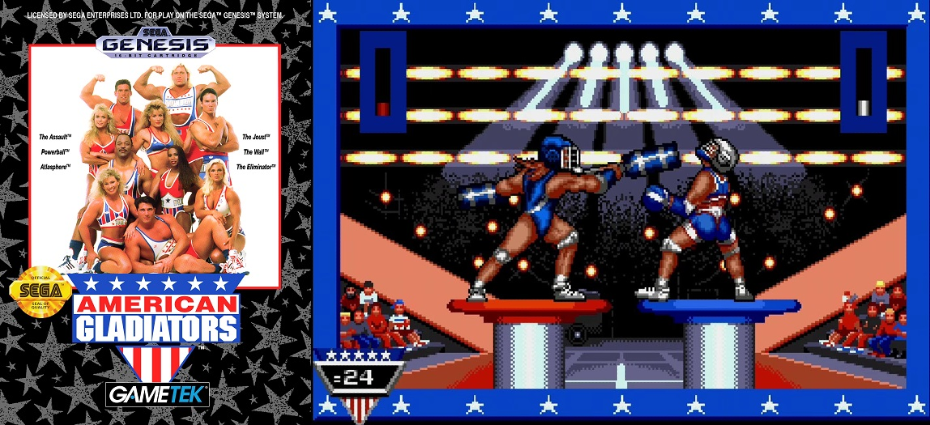
The story of the rise of the Gladiators in the UK could fill books (and probably has done!) - but that’s not the story I’m here to tell. Today we’re going right back to the series’ roots… back to the USA, where the Mega Drive is known as the Sega Genesis, and where in 1991 GameTek published a video game version of the original show. It’s Mega Drive Monday, and this is American Gladiators.
Contenders… READY!
To start off with, the game gives you a choice of Male or Female - although in both cases you’ll play the same events, so it feels simply aesthetic. Tournament mode pits you against CPU opponents in six events; win and you’ll play the same set of six in the next round, lose and it’s Game Over - or at least, straight back to the SEGA logo, as the game never actually tells you you’ve been eliminated. Head to head mode lets you take on a friend directly in one of the events - though only the ones where both contenders are in play together have true 2-player mode, mostly you’re taking turns battling gladiators.
Graphically the game looks fine, if a little basic. The sprites for the gladiators are virtually the same whether you’re facing Ice or Gold, Nitro or Laser - in fact if the game didn’t tell you before the round who your opponent will be, you’d never know the difference. Event arenas are spartan and grey, which matches the look of the American Gladiators series but is a bit drab for someone used to the flashier UK version!
In terms of music, the game has one single tune and plays it non-stop through every event and menu. It’s got a muddy, metallic bassline (characteristic of many Western-developed Genesis games) and a fast beat in a style that calls to mind nightly sports coverage. It’s appropriate to the game but gets very repetitve.
Beyond its looks and sound, each event plays completely differently, so let’s go through them…
Assasult: tennis balls at dawn

Known as Danger Zone in the UK version, contenders run between weapon stations trying to score a hit on the gladiator, while dodging their high-speed tennis balls. It’s one of the more technical games on the show and never a particular favourite of mine; this holds true in the video game, which suffers from an awful control scheme that has to practically be memorized: press B to switch to “weapon mode” at a station, then position yourself in front of the weapon and press C to pick it up, then use the D-pad to aim and B to fire, then C to put it down, B to return to field mode, run to the next station, repeat. All the while dodging shots from the gladiator - get hit once and the game ends. I was so busy trying to remember which button to press to get the weapon working that I barely had time to aim and fire the thing, never mind avoid getting hit!
Joust: weapon of choice, giant cotton bud

Called “Duel” in the UK, this event quickly became the show’s iconic centrepiece: a one-on-one battle with oversized foam cudgels atop small circular platforms, the simple task is to knock the gladiator off their platform before they can knock you off yours. Fittingly, in the game this event boasts the largest and most detailed spritework, and a pretty decent control scheme reminiscent of early boxing games: hold B to enter attack mode, or let go of it to remain in a guard stance, and press a direction to execute one of eight offensive or defensive moves. The game doesn’t give you much of a hint as to what your opponent is going to do so it’s just a question of finding an attack that works and scoring hits while randomly blocking and hoping you’ve got the timing right. I think I had the most fun with this event, but found it a bit unpredictable.
The Wall: BRING ON THE- no wait wrong show

Possibly the simplest concept in the show: race up a climbing wall and don’t let the gladiator catch you. In game it’s pretty simple too, although for some reason the game forces you to mash the B button while holding the D-pad in the right direction, and your contender does tend to get stuck on corners a lot. Not much else can really go wrong here and it’s otherwise unremarkable.
Atlaspheres: or, man vs. hamster ball

One of the show’s big spectacles, competitors are sealed inside giant metal spheres and have to roll around the arena, the contenders trying to hit target marks and the gladiators aiming to prevent them from scoring. This one readily translates to a video game: the controls are just right, the atlaspheres feel weighty and have good momentum, and the clash when a gladiator gets in your way is very satisfying - if frustrating! The only downside here is the incredibly restricted viewport: you only get a tiny square viewing window. Having a full view of the arena would have been fantasic - with some tweaks, you could make a full complete game of just this one event.
Powerball: a real lottery

Another big arena game, Powerball is a kind of cross between basketball and American football - grab a ball from the hopper, try to deposit it into a scoring basket. The gladiators are there to tackle you, hit the deck and your ball is out of play - run to the opposite side and try again. And that last aspect - that you always have to run to the other hopper after scoring or getting tackled - is what kills the video game version here. The game doesn’t give you any hint that you have to change sides, you just won’t pick up a ball when you try - I was standing in front of the wrong hopper mashing B like a lemon on more than one occasion. Compounding the problem is the need to be precisely in front of the hopper to pick up the ball, and the same for scoring - the movement controls just aren’t precise enough and most of my shots ended up “missing”. You’re stuck with the same tiny viewport as Atlaspheres too, hardly fitting for a field event like this.
The Eliminator: max finger stamina!

The traditional final event, a race around an assault course where the contenders face off with each other. The game version preserves the order of the American Gladiators’ event, with the infamous Travelator up first and a random gladiator with a blocking pad at the end - although if you pick the right lane, you won’t have to face the gladiator at all. (The UK version did away with the gladiators and moved the Travelator to the end, making for a much more nail-biting event, a real test of endurance.) Sounds exciting, eh? Well, to tackle this epic event in the game, you have to…. mash A and C repeatedly. It’s a bit like an athletics game’s track and field event - mashing the buttons gets you up the travelator, up the nets, across the beams and through the gladiators’ final challenge. The manual mentions pressing B in places to leap hurdles and pick a lane for the final sprint but the timing on these is hard to pull off while keeping up your furious button-mashing pace! All in all a bit of a disappointment for what’s supposed to be the final showdown.
Final Verdict
Being essentially a collection of minigames, American Gladiators is very uneven in quality. Joust and Atlaspheres are the standouts, being very playable with well-defined control schemes; The Wall and Eliminator are competent but lack excitement; while Assault and Powerball are badly let down by their fiddly control schemes. But that means that only one third of the game is actually any fun to play! And its deficiencies in presentation - single repetitve music track, generic sprites with no personality, tiny zoomed in window for big arena events - let it down too. Finally, the lack of any kind of settings or free play mode means you can’t practice only one of the events to get better at them. The game always forces you through each of the six events in the same order every time.
In conclusion, I wouldn’t have recommended American Gladiators back in the 90s, and I still don’t here. Try it out via emulation, play each of the six events once or twice, and you’ll have seen everything it has to offer in about ten minutes. It was apparently going to be released in the UK in 1992 but this never materialised - perhaps the negative critical reception soured the idea, or maybe the significant changes to the look and design of the show in the UK meant it needed more work than the devs anticipated - who knows? But I don’t think we missed out on much.
Scorecard (out of 5)
